
You’re not imagining it. That tension in the team meeting. The weird power dynamic during stand-ups. The silent resentment after a “helpful” suggestion lands the wrong way.
Sometimes it feels like everyone’s walking on eggshells. Sometimes we are the eggshells.
This month, I want to talk about a framework that has helped me (and many of my clients) make sense of these sticky situations: the Karpman Drama Triangle.
It sounds dramatic, but it’s painfully common in everyday work life.
The 3 Roles That Keep Us Stuck
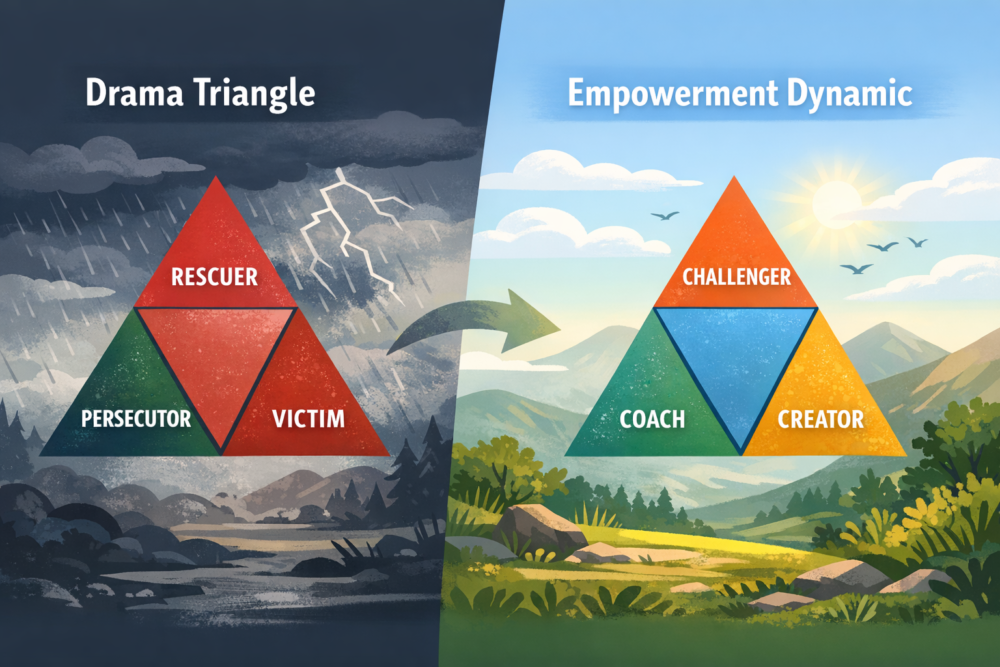
The Drama Triangle, developed by Stephen Karpman, outlines three roles we tend to fall into when conflict, stress, or miscommunication arise:
- ⛄ Victim: feels powerless or misunderstood. Think: “This always happens to me,” or “No one listens to me.”
- ⚡ Persecutor: criticizes or controls. Think: “They’re doing it wrong,” or “I have to fix this.”
- 🤝 Rescuer: swoops in to help, often without being asked. Think: “I need to save them,” or “Let me just take care of it.”
None of these roles are inherently bad. In fact, we often rotate between them in the same week — or even the same conversation.
Here are some examples I’ve seen in real teams:
- A mentee told me she dreaded stand-ups because a colleague constantly interrupted her. Over time, she stopped speaking up altogether. (Victim/Persecutor dynamic)
- Another mentee had a brilliant product idea, but when she shared it, a more senior colleague claimed credit for it. She didn’t push back and spent the next week doubting her worth. (Victim dynamic)
- In mentoring sessions, I’ve also noticed myself almost jumping in too fast when a mentee struggles. That’s Rescuer territory.
How to Step Off the Triangle
The book The Power of TED offers a powerful shift: Instead of staying stuck in Victim/Rescuer/Persecutor roles, we can step into:
- 🌟 Creator (instead of Victim): “What’s mine to choose here?”
- 💡 Challenger (instead of Persecutor): “What needs to be said — and how can I say it constructively?”
- 🎯 Coach (instead of Rescuer): “How can I support without taking over?”
This shift changes everything.
Because now, instead of reacting from emotion or ego, you’re responding with clarity and choice.
Instead of “I need to be heard,” you ask: “What’s the most effective way to get this across?”
Instead of “They messed this up,” you ask: “How can I challenge them while keeping the connection?”
Instead of “I’ll fix it for you,” you ask: “What support would help you move forward?”
🎥 Want a quick explainer?
This 3-minute video is a great intro to the Drama Triangle and how it shows up at work:
💭 My Two Cents
These aren’t just theories. I’ve watched the triangle show up in tiny moments:
When someone talks over us. When we feel invisible. When we try to help and end up making things worse.
It takes courage to shift from “I’m the victim” to “I’m the creator.” It takes self-awareness to stop rescuing and start coaching. It takes humility to turn criticism into a challenge.
But the reward? Clearer conversations. Healthier teams. More empowered careers.
🕒 Your 10-Minute Growth Ritual
Ask yourself:
- Where do I feel powerless or stuck at work?
- Am I trying to fix something that’s not mine to fix?
- Who am I trying to protect? And why?
- What would it look like to act as a Creator, Coach, or Challenger instead?
Write freely. Be honest. No judgment.
Let’s stop the drama. Not with silence or avoidance. But with awareness, intention, and a new set of roles.
I’ll see you next month — but until then, I’m here if you want to talk about how these patterns show up in your team or career.
Stay grounded,
Ana